
Quick Summary: Indoor air quality in 2026 is evolving with sensors, real-time responses, and standards-based cleaning. ARPA-H BREATHE teams have demonstrated early biosensor prototypes and autonomous airflow-response systems, with real-world installations planned for settings including schools and hospitals. New standards emphasize measurable airflow and safety, moving away from vague marketing claims. This shift improves health safety by integrating smarter controls, continuous monitoring, and layered cleaning strategies.
Indoor Air Quality is changing fast in 2026. ARPA-H and ASHRAE are pushing Indoor Air Quality beyond filters alone, with biosensors, risk software, and HVAC controls that react in real time. That matters because poor Indoor Air Quality now creates health, legal, and operating risk. This article covers healthcare-grade Air Quality Solutions, smarter Air Purification Systems, and standards-based proof that building air is being managed well.
What’s New in 2026: Buildings That Can Detect and Respond to Airborne Threats
How ARPA-H is changing the indoor air model
ARPA-H’s BREATHE program is pushing buildings past simple CO2 tracking. The new model is sense, assess, respond. That means indoor biosensors look for bioaerosols, software estimates health risk, and building controls trigger extra ventilation, filtration, or disinfection in real time, according to ARPA-H’s BREATHE program. In a July 2026 update, ARPA-H reported that teams had demonstrated early biosensor prototypes and autonomous airflow-response systems. The teams are tasked with reducing respiratory illness by 25% in the populations using their facilities, a goal that has not yet been reported as achieved, as outlined by ARPA-H’s 2026 update.
Why this matters for hospitals and other occupied buildings
Hospitals need this first, but the logic fits offices, schools, restaurants, and senior care too.
- Faster threat detection
- Targeted HVAC response
- Less guesswork during outbreaks
Buildings that react to risk can protect people without running max ventilation all day.
For teams like ACS Alma Cleaning Services, this shift makes clean ducts, tuned airflow, and verified HVAC performance more important, not less.
Also Read: Breathe Clean: Air Duct Cleaning Services | Alma Cleaning
The Biggest Practical Shift: Standards-Based Air Cleaning Instead of Marketing Claims
ASHRAE 241 changes the buying game. It asks for equivalent clean airflow, not vague promises. The standard sets minimum rules for reducing infectious aerosol risk in new and existing buildings, and it uses an Infection Risk Management Mode plus a building readiness plan to guide response during higher-risk periods, according to ASHRAE Standard 241 facts.
Right now, the most credible options are the ones with clear test methods and safe use rules:
- MERV-A 11+ or better filtration
- HEPA portable air cleaners
- Upper-room GUV/UVGI
CDC says upper-room GUV works as a supplement to ventilation and can provide clean-air effect similar to added air changes when designed well CDC GUV guidance.
Buyers should press vendors with simple questions:
- What clean airflow does this add in my room?
- What safety tests cover ozone, formaldehyde, and particles?
- What maintenance keeps performance real?
If a vendor leads with buzzwords instead of measured airflow and safety data, move on.
Also Read: Expert Cleaning Tips, Guides & Janitorial Insights
How Building Controls Are Becoming Part of the Air-Quality Toolchain
What real-time sensors can do now
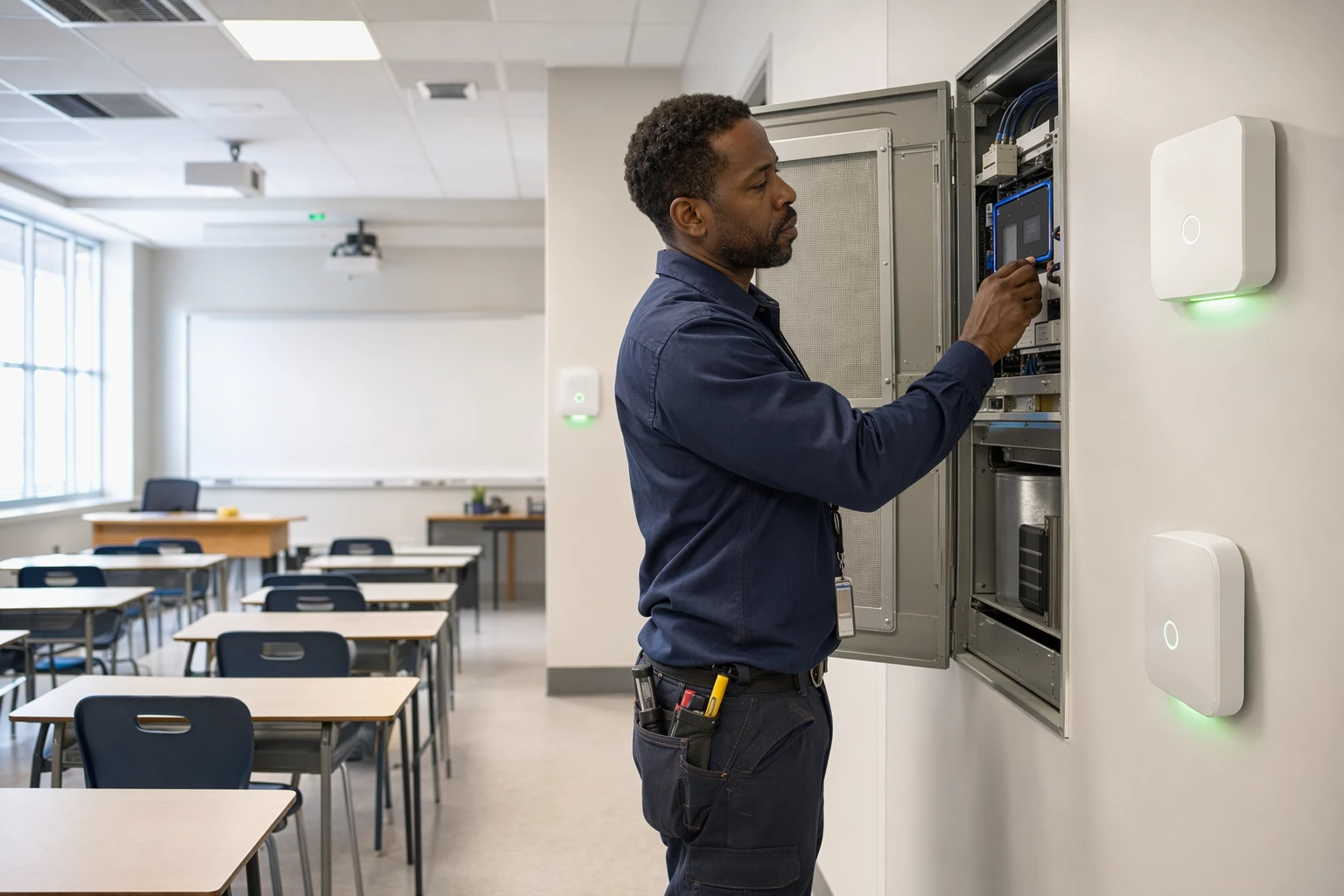
Real-time IAQ sensors now track CO2, PM2.5, humidity, temperature, and VOC spikes fast enough to guide daily HVAC moves. Colorado’s school program shows these systems already log live data and archive trends for action, not just reports, according to this IAQ monitoring webinar.
Why data alone is not enough
A dashboard does not clean air. Building controls matter when sensors trigger outside air changes, filtration shifts, purge cycles, or room-level cleaning. ASHRAE’s guidance lists IAQ sensors with data aggregation platforms as part of a broader response system, not a stand-alone fix, in this ASHRAE design guide.
Also Read: About Us | Alma Duct Cleaning Service
Why This Shift Arrived So Quickly
The post-pandemic reset for indoor air
COVID changed how owners judge indoor air. Clean air moved from a comfort issue to a health and risk issue. CDC still says better ventilation lowers exposure to airborne hazards and supports healthier buildings CDC guidance. That pushed faster upgrades in sensors, filtration, and UV systems. The 2026 WHO influenza guidance recommends against indoor air purification to reduce influenza transmission in community settings, noting that ventilation is preferable to air purification at large scale; it says air purification combined with other measures could be considered in specific settings such as hospitals WHO guidance.

Ready to improve your building’s air? ACS Alma Cleaning Services helps Michigan homes and businesses clean ducts, maintain HVAC systems, and support healthier indoor air.
Frequently Asked Questions
Q1: What are the latest advances in indoor air quality technologies for healthcare environments in the US?
Hospitals now use smarter IAQ sensors, better HEPA and UV-C air cleaning, and HVAC controls that react in real time to pressure, particles, and ventilation gaps.
Q2: How do recent indoor air quality control strategies impact patient safety and hospital infection rates across the US?
Cleaner, well-managed air lowers airborne risk, supports isolation spaces, and helps cut exposure during high-traffic periods, especially when teams track ventilation performance continuously.
Q3: What are the most effective indoor air quality improvements implemented in US schools and how do they enhance student health?
Top school fixes include better filtration, more outdoor air, portable air cleaners, and CO2 monitoring. These steps reduce stale air, support comfort, and may lower missed school days.
Conclusion
Indoor air tech is shifting from simple ventilation to continuous sensing, automated response, and layered cleaning. A 2026 NIST-authored ASHRAE Journal column reviews the development and future of indoor air monitoring in its discussion of sensors and AI, while EPA still stresses ventilation, filtration, and supplemental cleaning together in its layered approach guidance.